Description:
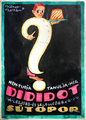
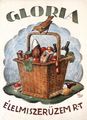
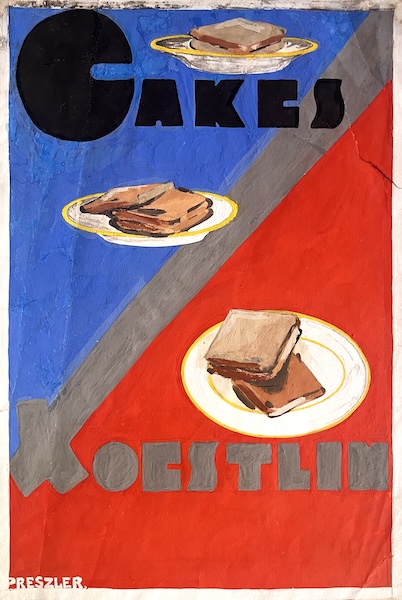
Koestlin Cakes is a Hungarian vintage original hand painted poster maquette by Mariann Preszler from around 1930.
The company was established from Hermann Bach's steam mill in Győrsziget and became the first biscuit factory of Hungary, in 1880. In 1892, however, Lajos Koestlin bought the factory. Koestlin had already had a biscuit factory in Bregenz, Austria but the competition was so stiff there that he moved to Hungary and brought all his equipment for biscuit-production with him in 6 stock-cars. He also invited 50 professionals and restarted work in the new country in 1900. The products of his factory included biscuits, rusk, ‘cvibak’ (rusk for the army), wafers and gingerbread. The company became successful, before the outbreak of the First World War it already employed about 1000 workers. As the fights started and the needs of the citizens of Hungary and of the army increased rapidly, the company fulfilled a rising number of orders – the products of the Koestlin factory were demanded all over the Austro-Hungarian Monarchy and the factory in Győr became the acropolis of Hungarian biscuit-production.
After the First World War the production was cut down because of the lack of ingredients, and the number of employees was reduced to around 500. To balance the situation, the factory started producing chocolates and bonbons in 1922 and candies in 1925. By 1926 the company was exporting to 14 countries, and in the 1930s it had 334 different kinds of products.In 1931 the company was reformed as a Public Limited Company and in spite of the effects of the Great Depression, it retained its variety of products. Under the German occupation, however, it was declared a factory for war efforts and restarted the production of only biscuits, wafers and rusk. In 1945 the factory again had to suffer from the lack of money and ingredients, so the production was suspended for 4 months after which the factory was ordered by the mayor of Győr to serve the public demands. The production halls were even let to the coalition of the Hungarian Commercial Bank of Pest and the Leipziger Vilmos Szesz és Cukorgyár (Liquor and Sugar Factory of Vilmos Leipziger). Although being nationalised in 1947, the factory was declared to be independent again in 1948 by the Minister of Agriculture of the time, and in 1950 the factory was reformed for the third time as the Győri Keksz és Ostyagyár Nemzeti Vállalat (National Company of Biscuit and Wafer Factory of Győr). In 1963 the status of the factory changed again, since all the 6 confectionery factories of the country were converted into a general one, namely the Magyar Édesipari Vállalat (Hungarian Confectionery Company). (source: wikipedia.org)